
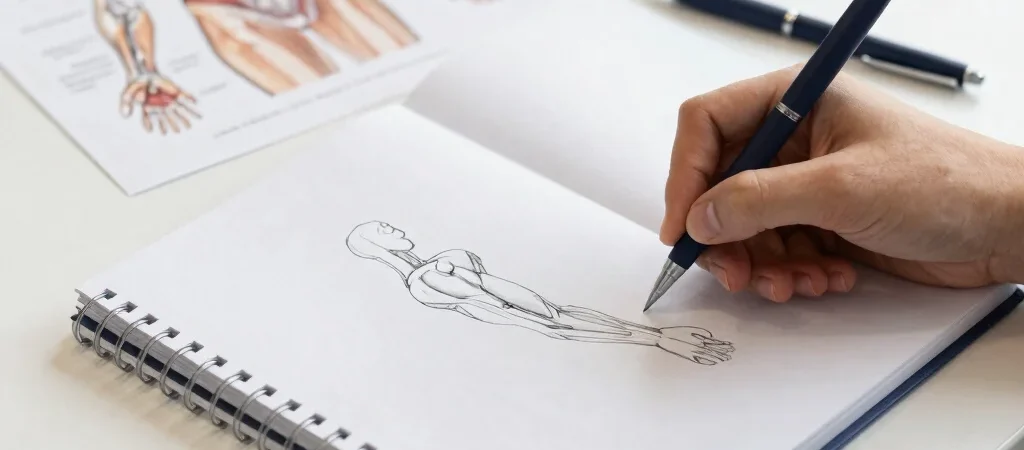
An anatomy flashcard may ask you to name a structure, but an exam can also ask where it sits or what lies beside it. Those are different kinds of recall. I find it more useful to study a structure as part of a map than to memorize its name in isolation.
Start With Landmarks
Before drilling smaller structures, identify a few landmarks from your course diagram or lab materials. For a region of the arm, that might mean orienting yourself to the shoulder, elbow, and major bones before adding muscles, nerves, and vessels. Landmarks give you reference points when a label is covered or an image is rotated.
Redraw, Then Check
Put the diagram away and make a rough sketch from memory, focusing on where structures sit in relation to one another rather than on artistic detail. Add labels only after the basic layout is in place. Compare your sketch with the original and note specific mix-ups, such as reversing two neighboring structures or placing one on the wrong side.
Ask More Than What
Turn each label into a small set of questions: Where is it? What is next to it? What does it do, according to your course materials? You can also cover labels on a diagram and point to each structure before naming it. That practice connects recall to position, which is exactly what a flat list of definitions leaves out.